I’ve been a designer for twenty years. In that time I’ve worked with managers and I’ve worked with leaders, and there is a difference. The best leaders I had made it safe to not know something yet, explained why the work mattered and treated my growth as part of their job.
Those qualities have never mattered more than they do now. Designers are being asked to work with tools that didn’t exist a year ago, on products that behave in ways we’re still learning to describe. Some are excited. Some are quietly worried about what it means for their craft. Most are a bit of both.
Leading in that moment isn’t about having every answer. It’s about creating the conditions where a team can find them together, and it starts with being honest about how the change feels.
Change is easier to face when you don’t have to face it alone.
Name what the change feels like
In a recent conversation on Lenny’s Podcast, Molly Graham described a shift a lot of us feel: the job used to be rowing, and now it’s steering. For many designers the honest response is “but I liked rowing.” The craft we fell in love with is changing, and that comes with a real sense of loss.
The instinct as a leader is to jump straight to the opportunity. But people can’t lean into change while they feel unheard. Sometimes the most useful thing you can do is say it out loud: this is exciting, and it’s also hard.
Acknowledging how hard change is doesn’t slow a team down. It’s what lets them move.
Safety comes before speed
Once people feel heard, they need to feel safe to try. Imagine a designer three weeks into using an AI prototyping tool. Their first attempts were messy, and the output looked nothing like the team’s work. In the critique, they show only the polished version, built the old way.
Nobody learned anything from that meeting. The designer didn’t get help with what was hard, and the team missed a chance to see what the tool could and couldn’t do.
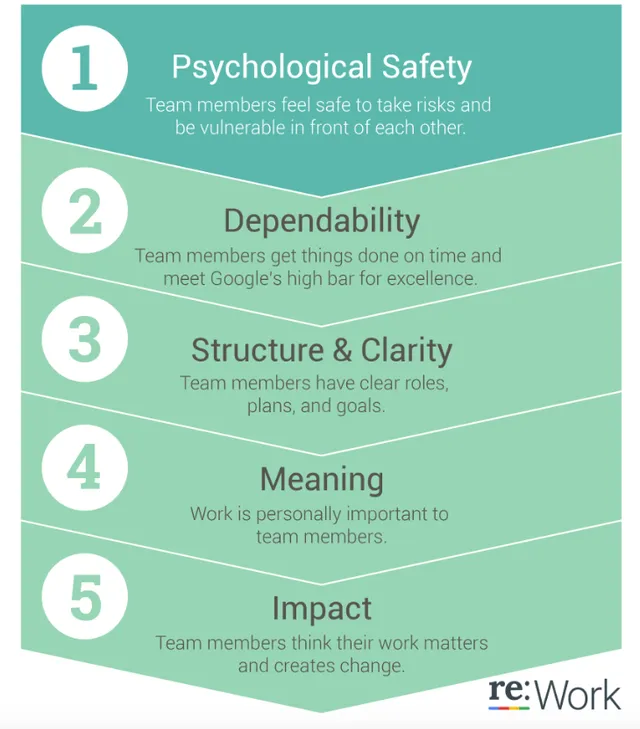
Google’s Project Aristotle found that psychological safety was the strongest predictor of how well a team performs. In practice it’s built from small, repeated signals: a leader sharing their own failed experiment, a critique that asks “what did you learn?” before “is it finished?”, and room for half-formed ideas. A team that can learn out loud will always move faster than one that has to look certain.
If people have to look confident, they stop experimenting.
Purpose travels further than process
Safety gives people the courage to experiment. Purpose tells them where to point it. Simon Sinek’s Golden Circle puts it simply: start with why. When designers understand why the work matters, to customers and to the business, they make better decisions without waiting to be told.
That matters more now that building is faster and cheaper than ever. When a working prototype can exist by the afternoon, the scarce skill is no longer making the thing. It’s knowing what is worth making, for whom, and how it should feel when it reaches them.
It also means owning the result. To borrow Molly’s framing, AI right now is less a genius colleague and more a keen intern. Nobody would forward an intern’s first draft straight to their boss, yet AI output is often copied, pasted and sent. You can delegate the doing. You can’t delegate the judgement.
As building gets cheaper, judgement becomes the job.
Speak the language of the business
That judgement only counts if the rest of the business can see it. Design earns its seat by showing its value in terms everyone already uses, not as “us and them” but as partners solving the same problem. I keep coming back to three things: what the work does for customers, what it does for revenue and cost, and how it makes a product genuinely different.
AI has sharpened this conversation. Leaders across the business are asking what AI can do. Designers are often best placed to answer the harder question: what will people actually trust, use and come back to?
Design’s value is clearest when it answers the business’s own questions.
Make 1:1s about the person
All of this lands, or doesn’t, one person at a time. A 1:1 that turns into a project update is a missed opportunity. The time is better spent understanding where someone wants to grow, what’s getting in their way and what support would help. Honest, specific feedback, given often, builds more trust than praise ever does.
Right now, that often means helping designers see a future for their role. Molly shared a question from the journalist Manoush Zomorodi that I’ve found useful in these conversations: what would you do if you believed your job was always going to exist, but would look completely different every six years? It moves the conversation from protecting what design was to shaping what it becomes.
Invest in the designer, not just the deliverable.
Systems free people to do their best work
People grow fastest when they’re spending their time on the problems that matter. A well-maintained design system, and the operations around it, take away the friction that isn’t design.
That system now has a second audience. At Lendi Group we’ve built a design system that AI agents use to generate interfaces. The patterns, tokens and guidance have to be clear enough for a machine to follow as well as a person, which turns out to be a very good test of whether they were ever clear at all.
If an agent can’t follow your design system, a new designer probably can’t either.
Learn the new tools by building together
Systems and safety set the stage, but the fastest way I’ve found to help a team through change is to make things side by side. I run hands-on training and agent-building workshops, and I’ve organised and judged hackathons where designers, engineers and product people experiment together.
It has changed how we design at Lendi Group too. With an AI prototyping tool in the room, we no longer gather ideas in a meeting and come back days later. Designers, engineers, product and leadership shape a working prototype together, on the spot. We now get five or six ideas deep instead of running with the first one or two, and a validated prototype takes a day or two rather than a week. More voices contribute, and designers still shape those ideas into something ready to test with customers.
Something shifts when people see a teammate build something real in an afternoon. The tool stops being abstract, and the conversation moves from “should we?” to “what could we do with this?” And because leaders are role models whether they intend to be or not, how you use these tools in the open becomes how your team uses them.
Curiosity spreads when people can see and touch the result.
What this means for design leaders
A few questions I find useful to ask of a team, especially in a period of change:
- Have we named what this change feels like? People can say what they miss about the old way of working without it being treated as resistance.
- Is it safe to share unfinished work? People show experiments, not just polished outcomes, and mistakes are treated as information.
- Does everyone know why the work matters? Designers can explain the customer and business purpose without being prompted, and own the quality of what they ship.
- Are 1:1s about growth? Conversations focus on the person’s development, not only on project status.
- Are we learning the new tools together? The team experiments side by side rather than leaving each person to figure it out alone.
The tools will keep changing, faster than they ever have. The habits that make someone a good leader don’t. Stay curious, make room for the hard feelings as well as the exciting ones, and keep listening. If you’d like to talk about design leadership, AI or mentorship, I’d like to hear from you.
 Further watchingMolly Graham: The grief, burnout, and opportunity hiding inside the AI transitionLenny’s Podcast
  Further watchingHow Great Leaders Inspire ActionSimon Sinek, TED