Since 2001 I’ve been part of a community group that runs local festivals, seminars and events. It taught me the same lesson as product design: if you don’t understand the people you’re designing for, they won’t show up. A beautifully organised festival that doesn’t speak to its community is still an empty field.
As AI takes on more of the work, from analysing research to answering customers directly, it’s tempting to think empathy matters less. A model can summarise a thousand conversations in seconds. It can predict which option someone is likely to choose.
But predicting what someone will do is not the same as understanding why they do it, or how it feels to be them in that moment. That part is still ours, and it matters most exactly where AI meets people.
The more work AI does on our behalf, the more empathy has to be designed in.
Completing the task isn’t the whole experience
Imagine someone calling about their home loan late on a Sunday night. Their fixed rate ends next month and they’re worried about their repayments. An AI voice agent answers, finds their details and books a call with a broker for Monday morning.
Measured on the task, that’s a success. But did they feel heard? Do they know what happens next, and who they’ll be speaking to? Did they hang up calmer than when they called?
Those questions don’t show up in a completion rate. They’re empathy questions, and they decide whether someone trusts the experience enough to use it again.
A completed task and a good experience are not the same thing.
Faster research still needs real people
The only way to answer those questions is to ask the people themselves. Interviews, usability testing, watching people in context and diary studies are still how empathy is built, with analytics showing where to look.
What has changed is speed. AI can help us transcribe and synthesise interviews, spot themes across hundreds of conversations and prototype an idea before lunch. That’s a gift, as long as it gives us more time with people rather than less.
A summary of what customers said is not the same as hearing it in their own words. The pause before someone answers, the workaround they don’t think to mention, the worry in their voice on a Sunday night: that’s often where the real insight lives.
Let AI speed up the analysis, not replace the listening.
Shared pictures keep the person in the room
What you learn from people only helps if the whole team can hold onto it. Personas and empathy maps give a team the same picture of who they’re designing for. Organising what someone thinks, feels, says and does is often where the emotional moments that matter most become obvious.
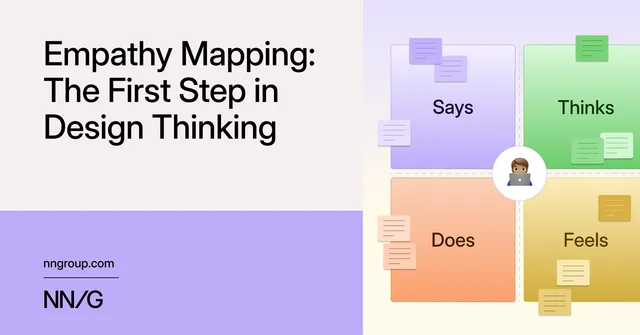
They only work if they stay grounded in real research and stay current. A persona nobody has checked in a year is a guess with a name.
A persona is only as good as the last time you checked it against reality.
Empathy is a practice, not a phase
Keeping those pictures current matters even more with AI, because the product itself can change underneath them. As models, prompts and context shift, so does how the experience feels, sometimes in ways no one intended.
A change that improves accuracy might make an assistant sound colder. A faster response might feel rushed to someone who’s anxious. The only way to know is to keep testing with people, keep listening and keep refining.
If the product keeps learning, so should we.
Stories are how empathy travels
Research and testing build empathy in the people who did them. Stories are how it reaches everyone else. Findings in a report rarely change minds, but a well-told story about a real customer often does.
The person calling on a Sunday night, worried about their repayments, is far easier for a whole team to hold onto than a satisfaction score. Stories make complex ideas easier to grasp, bring stakeholders onto the same page and keep the human at the centre of decisions that might otherwise become purely technical.
Tell the story of one person, and the whole team will design for them.
What this means for design
A few questions that help keep empathy at the centre of AI-native work:
- Do we know how people feel, not just what they did? Success measures include confidence, clarity and trust, not only task completion.
- Are we still talking to people directly? AI speeds up synthesis, but the team still hears customers in their own words.
- Are our personas current? They’re grounded in recent research and updated as behaviour changes.
- Do we test as the product changes? Model, prompt and context changes are checked with people, not just against benchmarks.
- Can the team tell a real customer’s story? Decisions are anchored in a specific person and situation, not an abstraction.
Empathy is one of the few parts of design that can’t be automated, and that’s exactly why it matters more now. Whether it’s a community festival or an AI-native product, understanding people is still how we make things that genuinely make a difference.